
What Aesthetic Treatments Should Men Ask For?

For a lot of men, the hardest part of aesthetic treatments is knowing how to explain what they want.
Many men are not walking into a clinic saying, “I want Botox,” “I’m interested in dermal filler,” or “I think I need skin tightening.” They may not know the treatment names. They may not know what is possible. They may not even know whether the thing bothering them is caused by wrinkles, volume loss, skin laxity, facial heaviness, or simply looking more tired than they feel.
They may say:
“I look angry all the time.”
“My face looks heavier.”
“My jawline disappeared.”
“I look tired on Zoom.”
“I feel like I aged overnight.”
“I just want to look better.”
And that is exactly where the conversation around men and aesthetic treatments needs to change. Because men are not necessarily avoiding aesthetics because they are uninterested. Many are avoiding it because they do not know where to start.
Aesthetic treatments for men
Men often describe the problem, not the treatment
Women are often more familiar with aesthetic language. They may know the difference between Botox, filler, laser treatments, skin boosters, chemical peels, body contouring, or jawline contouring. They may have seen the treatments on social media, heard friends talk about them, or followed providers who explain the process.
Men are usually coming from a different place.
They are more likely to describe what they see in the mirror rather than the treatment they think they need. They may notice deeper lines between the brows, but they do not know that this could be treated with Botox. They may notice their lower face looks softer, but they may not know whether that relates to jawline definition, skin laxity, or weight changes. They may feel like their face looks tired, but they may not know if the issue is under-eye hollowing, skin texture, volume loss, or simply facial tension.

This is why male aesthetic marketing needs to be less treatment-first and more outcome-first.
Instead of starting with, “Do you want Botox?” the better question may be:
Do you want to look less tired?
Do you want to look less tense?
Do you want your jawline to look sharper?
Do you want to look more rested in photos?
Do you want to look like yourself, just a little fresher?
That kind of language meets men where they are.
The fear is not always the treatment, it is the unknown
Many men are open to aesthetic treatments in theory, but the unknown result holds them back. They may worry the change will be obvious. They may worry they will look frozen, puffy, feminine, or unlike themselves. They may worry that if they ask for the wrong thing, they will end up with a result that feels too dramatic. For men, subtlety is often the priority.
Most are not looking for a transformation that makes people ask what they had done. They want to look sharper, healthier, more awake, and more confident without announcing that they had an aesthetic treatment.
That is why not knowing what to ask for becomes such a big barrier. If a man does not know whether he needs Botox, filler, skin tightening, or something else entirely, the decision can feel risky before it even begins.
He is not just asking, “What treatment should I get?”
He is really asking, “Will this still look like me?”
Why before-and-after photos are not always enough
Before-and-after photos can be helpful, but they are not always the best starting point for men. Many aesthetic before-and-after galleries still feature mostly women. Even when male results are available, it can be hard for someone to know whether that result applies to their own face, age, skin type, facial structure, or goals.
A man may see a jawline filler result and wonder if it would look too sharp on him. He may see Botox results and worry about losing expression. He may see under-eye treatment and not know whether his own concern is even the same issue.
This is where generic examples fall short.
Men do not just need to see what treatments can do for someone else. They need to see what subtle improvement could look like on their own face.
How the AI Simulator helps men start the conversation
The AI Simulator gives men a more private, visual, and approachable way to explore aesthetic treatments. Instead of needing to know the correct treatment name, users can begin with what they actually care about: how they want to look.
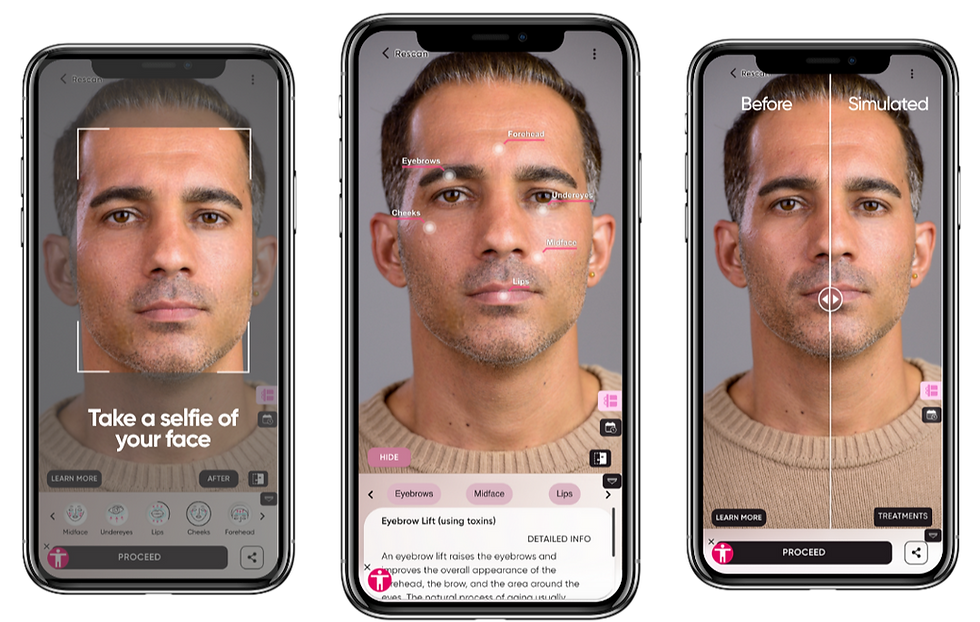
They can visualize a more refreshed version of themselves. They can explore what a softer frown area, sharper jawline, smoother skin, or less tired-looking appearance may look like on their own face. This helps make the decision less abstract and less intimidating.
Men do not want to sit in a consultation trying to describe something they cannot fully explain. They want to see possibilities first. They want to understand what “natural” or “subtle” might actually look like for them before they commit to a conversation, a provider, or a treatment plan.
The AI Simulator helps turn vague concerns into clearer goals. Instead of saying, “I just look older,” a man may be able to say, “I like how my face looks more rested here, but I still want to keep movement around my eyes.” Instead of saying, “I look angry,” he may be able to say, “I want the lines between my brows softened, but I do not want to look frozen.” That kind of clarity can completely change the consultation experience.
Men want results that feel masculine, not overdone
Another major reason men do not know what to ask for is because they are often afraid the aesthetic world was not designed for them. They may associate injectables with a look that feels too smooth, too sculpted, or too feminine. They may worry that the same treatment approach used on women will be used on them.
But male aesthetics should be different.
A good treatment plan for men should respect masculine facial structure, stronger muscle movement, thicker skin, facial hair, and the features that make a face look strong. The goal is usually not to soften everything. It is often to restore balance, reduce fatigue, and keep the face looking natural.
For some men, that may mean softening deep frown lines so they look less tense. For others, it may mean improving skin texture, defining the jawline, reducing under-eye tiredness, or creating a more refreshed overall appearance.
The right result should not make a man look “done.” It should make him look like he slept better, feels healthier, or has more energy.
Father’s Day is the perfect time to change the conversation
Father’s Day is usually filled with gifts like tools, watches, golf gear, cologne, or a nice dinner.
But maybe it is also a good time to talk about something many men quietly care about: confidence.
Dads, husbands, and men in general are allowed to want to look good. They are allowed to notice that they look more tired than they feel. They are allowed to want to feel more confident in photos, at work, on video calls, or when they look in the mirror. And they should not have to know every treatment name before they start exploring their options.
That is what makes the AI Simulator so useful. It gives men a simple first step. No pressure. No guessing. No need to walk into a consultation already knowing the difference between Botox, filler, lasers, or skin tightening.
They can start with the result they want to see.

Aesthetic treatments for men should start with the right question
The question is not always, “What treatment do you want?” For many men, the better question is:
What do you want to look less like?
Less tired?
Less angry?
Less heavy?
Less aged?
Less stressed?
And then:
What do you want to look more like?
More rested?
More defined?
More confident?
More like yourself again?
That is where aesthetic treatments become more approachable for men. Not as beauty treatments. Not as a dramatic makeover. But as subtle, personalized maintenance that helps them feel more aligned with how they want to show up.
The AI Simulator makes that process easier by helping men see what is possible before they have to explain it. Because many men already know they want to look better. They just need a better way to see it, understand it, and ask for it.


Comments